
The Muay Thai Clinch for Beginners: The Part That Completes Your Game
The clinch is Muay Thai's grappling range: the standing battle for control that begins the moment two people take hold of each other, and the part of the sport most gyms in Singapore never teach properly. Punches, kicks and knees at range are only three quarters of Muay Thai. The clinch is the quarter that completes the game, which is why Pineapple MMA at 139 Cecil Street, two minutes from Telok Ayer MRT, runs Muay Thai Clinching as a class of its own. It is also the range where a beginner's effort pays back fastest, because the clinch is won with position and problem-solving, not size.
What the Clinch Actually Is
The clinch starts where punching ends: chest to chest, both people gripping for control of the head, neck and arms. It is not a pause in the fight, and it is not brawling. It is a defined phase of Muay Thai with its own scoring: controlling posture, landing knees to the body, turning and off-balancing an opponent, and sweeping them to the canvas all win rounds in Thai stadiums. Someone with a strong clinch can drag an exchange into a range where the other person simply has no answers, which is why it is drilled daily from childhood in Thailand, alongside the five core techniques every student learns first.
For students, the clinch is also the most honest teacher in the gym. There is no faking position: either your posture is strong or your partner bends it, either your balance holds or you stumble. Nothing else in training gives feedback that immediate.
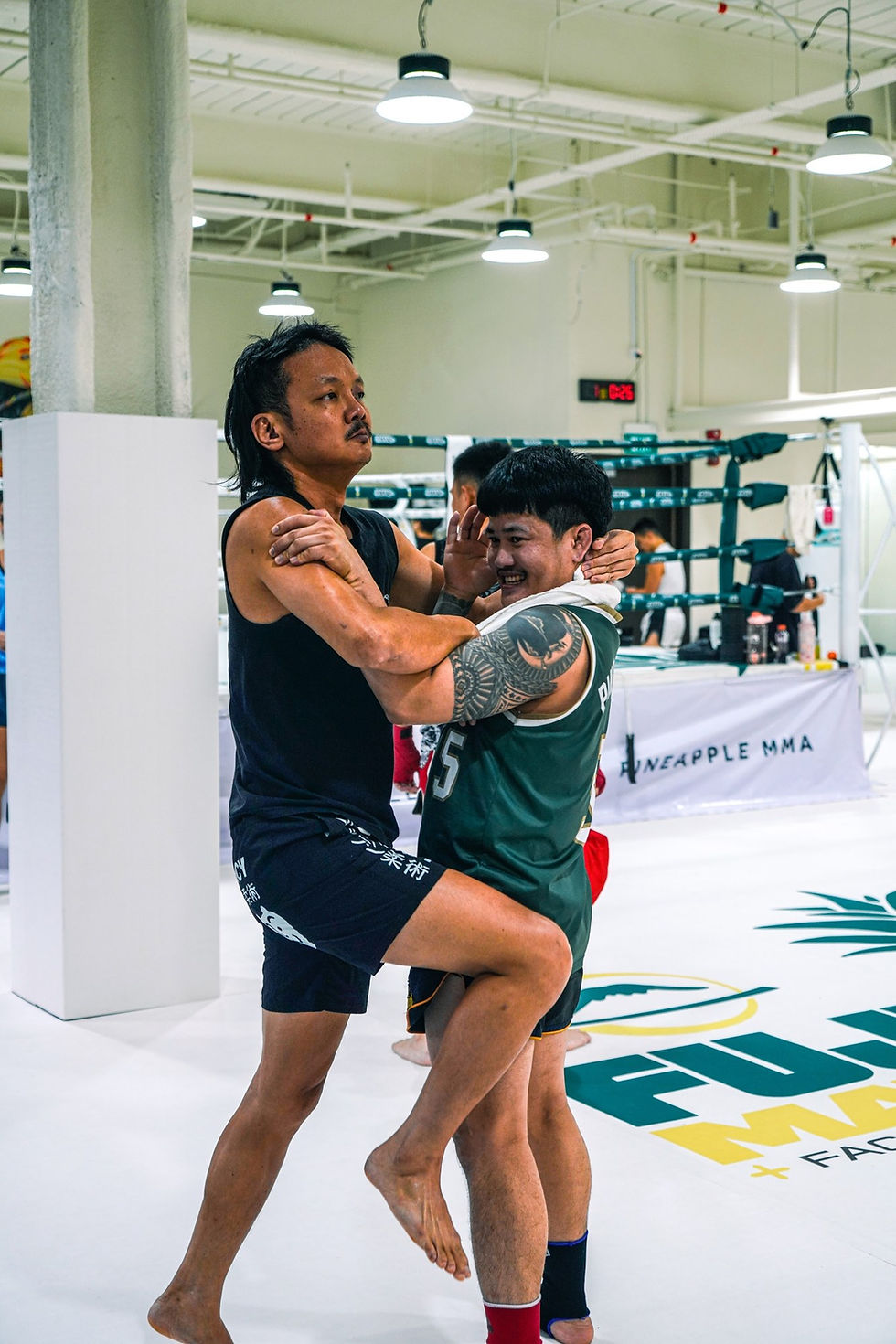
Why the Clinch Completes Your Muay Thai
Muay Thai is the art of eight limbs, and the clinch is where most of the knees and a good share of the elbows are actually thrown. A student who can punch, kick and teep at range but cannot hold position chest to chest has learned most of a striking art and only part of the Thai one. Our coaches put it plainly: if you have trained Muay Thai for a while and still cannot clinch, you do not yet know Muay Thai. In Bangkok's stadiums, clinch control decides rounds, and the greatest Muay Thai fighters built careers on it.
It is also the range that separates Muay Thai from kickboxing. Take the clinch away and what remains is very good kickboxing. Put it back and every other technique changes: your kicks become harder to sweep, your teep more stable, your guard taller, and composure at close range becomes something you own rather than something you hope for.
Why So Few Gyms in Singapore Teach It
Two things keep the clinch off most timetables. Coaches who did not grow up in it cannot teach it in depth, so gyms without Thai-trained coaches skip it or cover it thinly. And even at gyms with Thai trainers, clinch work often gets dropped from the group class because some members would rather not do it: it is close contact, it is unfamiliar, and it is easier to leave out. The result is a city full of people who have trained for years and still freeze the moment someone takes hold of their neck.
At Pineapple MMA we think the clinch is too important to leave out, so rather than squeezing it into every Core class we built a whole class around it. Muay Thai Clinching is a class of its own on our schedule, taught by coaches who fought professionally and know the range from the inside. If you want to learn the clinch, it is there on the timetable. If close contact is not for you, Core stays exactly as it is.
A Chess Game, Not a Strength Contest
From the outside the clinch looks like a wrestling match. From the inside it is closer to chess. Every exchange is a question about position: whose arms are inside, whose hips are underneath them, whose head is being controlled. Strength matters less here than almost anywhere else in the sport, because a strong grip in the wrong place is simply a lever your partner owns. What wins is control, positioning and the habit of thinking your way out of a bad spot rather than straining against it. That is why a lighter, calmer training partner so often takes a bigger one off balance at drilling pace, and why the clinch rewards patient students more than powerful ones.
The Positions Every Beginner Learns First
The plum (double collar tie)
The iconic clinch position: both hands clasped behind your partner's head, forearms clamped along the collarbones, elbows squeezed together in front. Control of the head is control of the spine, and control of the spine is control of everything. From the plum come knees, turns and most of the sweeps beginners learn. Defending it, keeping your posture upright while someone works to bend it, is the first clinch skill anyone develops.
Arm control (inside position)
Whoever has their arms inside, wins. The battle for inside position, sliding your arms between your partner's, is the clinch's constant underlying game, played on grips and angles rather than strength. An arm inside controls a shoulder or the head; an arm outside is a lever your opponent owns.
The frame and posture
Defence in the clinch starts with posture: spine tall, hips underneath you, head up. A frame, forearm braced against the chest or hip, buys the space that keeps knees from landing and sets up your own attacks. Beginners spend their early sessions learning simply to stay upright and relaxed under pressure, and that lesson alone changes how they carry every other technique.
Sweeps, Turns and Knees
The clinch's weapons come in three families. Knees strike upward into the body from control positions, the highest-scoring strikes of the range. Turns twist an off-balanced opponent past their base, forcing a stumble that scores heavily and looks even worse than it feels. Sweeps finish the job, timing a foot or a hip against a moment of broken balance to put an opponent on the floor. Beginners drill all three cooperatively, at walking pace, because the techniques are about timing and angles rather than force. A well-timed sweep by a smaller student on a larger one is a weekly sight in any clinch class, and it is the moment most people fall in love with this range.
How Beginners Train the Clinch Safely
Clinch training is grappling, not striking, which makes it one of the safest parts of Muay Thai to practise with a partner. Beginners start with cooperative position drills: swimming for inside control, holding and escaping the plum, walking through turns and sweeps with a partner who allows them. Intensity rises only as skill does, and knees in drilling touch the body rather than drive into it. Think of the session as closer to a technique class or a jiu-jitsu class than a conditioning session: basic drills and positions, with the clinch in place of the kicks and punches. Our guide to how live training is introduced covers the same step-by-step approach for striking.
Gear is minimal. Gloves and hand wraps are not compulsory for clinching, and because nobody is being struck at range there is no need for shin guards or sparring equipment.
What Happens in the Clinching Class
Muay Thai Clinching is a standalone class at Pineapple MMA, with current times on the class schedule. The hour is built from grips outwards:
Warm-up and movement: getting the shoulders, hips and grip ready before any contact begins.
Grips and inside position: how to get the inside position, how to break a grip, and how to stop giving your partner the one they want.
Control, off-balancing and knees: turning position into output, with sweeps, turns and knees landed from a controlled position rather than a scramble.
Controlled partner rounds: clinch-only work at the end of the hour, technical and continuous rather than a wrestling match, under coach supervision.
It suits anyone who has done some training in Muay Thai Core and is comfortable working closely with a partner. There is no time requirement and no sparring requirement: it is a separate class from Muay Thai Sparring, and you do not need to spar to attend. Every class sits on one membership, so clinching is an addition to your week rather than a replacement for anything, and it pairs naturally with Muay Thai Technique, which covers clinch range in some sessions.
Your First Clinch Game, in Order
Clinch skill builds in a reliable sequence, and knowing the order stops beginners trying to learn sweeps before they can stand up straight. The progression most students follow looks like this:
Posture first: staying tall and relaxed while a partner hangs weight on your neck. The early sessions are mostly this, and it is harder than it sounds.
The swim: sliding arms inside to recover position, drilled as a continuous cooperative loop with a partner.
Holding and breaking the plum: feeling what real head control is like from both ends, and learning the escapes.
Straight knees from control: the clinch's bread-and-butter strike, into pads held at the hip.
The first turn: using a grip and a step to move a partner past their balance. The moment this works on someone bigger is usually the moment the clinch becomes your favourite part of training.
Basic sweeps: timing a partner's stepping foot, added once turns are reliable.
None of this requires strength, which is the running theme of the range. It requires patience, posture and repetition, and each piece makes the next one available. Because so few people train the clinch at all, it is also the part of Muay Thai that improves fastest: a dedicated hour on it is enough to stop it being the part of your game that falls apart under pressure.
Frequently Asked Questions
What is the clinch in Muay Thai?
The clinch is Muay Thai's standing grappling range, where two people grip each other's head, neck and arms to work for control. Unlike boxing, which separates people who tie up, Muay Thai scores clinch work highly: knees, turns and sweeps from the clinch are match-winning techniques in Thai stadium rules, and at Pineapple MMA it has its own weekly class.
Is clinch training safe for beginners?
Yes. Clinch drilling is grappling rather than striking, practised cooperatively at controlled intensity. Beginners at Pineapple MMA learn positions, grips and balance with partners who allow the techniques, and intensity rises only with skill. It is technical rather than rough, closer to a technique class than a fight, and coaches set the pace throughout.
What is the plum in Muay Thai?
The plum, or double collar tie, is the clinch's signature position: both hands clasped behind the opponent's head with forearms clamped on the collarbones and elbows tight. Controlling the head controls the opponent's posture and balance, making the plum the platform for knees, turns and sweeps. It is the first position taught in the Pineapple MMA clinching class.
Is there a dedicated clinching class at Pineapple MMA?
Yes. Muay Thai Clinching is a class of its own at Pineapple MMA, 139 Cecil Street, separate from Muay Thai Core and Muay Thai Sparring and included in every membership. Current class times are on the schedule page, which is the place to check because the timetable can change.
Do I need experience or gloves to join the clinching class?
Some Muay Thai Core training helps, because the class assumes you are comfortable moving and making contact with a partner, but there is no fixed time requirement and the class does not assume you know anything about the clinch itself. Gloves and hand wraps are not compulsory for clinching at Pineapple MMA.
The Range Where Technique Wins
Every beginner eventually has the same experience in the clinch: a smaller, calmer training partner dismantles their balance like it was never there, gently, at drilling pace, smiling. That is the whole argument for learning this range. The clinch is where Muay Thai's promise, that technique beats strength, stops being a slogan and becomes something your own body proves every time you train it. Learn it, and your Muay Thai is finally the whole thing.
Learn it from the source. Pineapple MMA, 139 Cecil Street, #14-01 YSY Building, two minutes from Telok Ayer MRT, open weekdays 6.30am to 10pm and weekends 9am to 4pm, with classes seven days a week. Start with a $38 trial class, then add the clinching class to your week. Every class, clinching included, is on one membership.


Comments