_edited.png)
Why More Women in Singapore Are Choosing Muay Thai Over the Gym
- Mar 6
- 8 min read
The gym works. This is worth saying upfront, because what follows is not an argument that it does not. Thousands of women in Singapore maintain their fitness, manage their weight, and generally feel better about their health through consistent gym training. The gym is fine.
What the gym is less good at is keeping people going. Research and gym operators consistently point to the same pattern: roughly 90 percent of people who start a new fitness routine quit within three months. Not because they lacked discipline or genuinely did not want results. The motivation at the start is usually real. What fades is the reason to continue showing up once the novelty has gone. For a growing number of women in Singapore, Muay Thai has started filling that gap, not because it promises more dramatic results, but because it gives you something to actually think about while you are doing it.
That distinction sounds small. Over twelve months of training, it is not.
The Singaporean Fitness Landscape, Briefly
Women here have no shortage of options. ActiveSG gyms are affordable and accessible. Commercial gyms like Pure Fitness and Fitness First offer solid equipment and group class programmes. Boutique studios running HIIT, cycling, and reformer Pilates have multiplied across the island over the past decade. The infrastructure for fitness in Singapore is genuinely good.

The challenge is not access. It is engagement over time. Most fitness formats, however well designed, eventually become routine. The body adapts, the mind follows, and the motivation to keep showing up becomes something you have to manufacture rather than something that arrives on its own.
Muay Thai does not solve this problem by being harder. It solves it by giving you something to learn.
A Smarter Pairing for Women Who Already Lift
Weight training is excellent. It builds lean muscle, supports bone density, and improves metabolic function. Many women who train seriously have already figured this out and are not looking to be told otherwise.
What weight training does not do particularly well is cardiovascular conditioning. The standard solution is to add cardio: a treadmill session, a stationary bike, a stint on the elliptical. These work in the technical sense. They are also, for most people, somewhere between tolerable and genuinely tedious.
Muay Thai sits naturally alongside a weights programme as the cardio component that does not feel like cardio. Three to four sessions a week is where most women find their conditioning improves noticeably, and it fits comfortably around a weights schedule without requiring you to give anything up. The interval structure of pad rounds develops cardiovascular fitness efficiently, and the technical nature of the training means your attention is elsewhere instead of fixed on how long this is going to take.
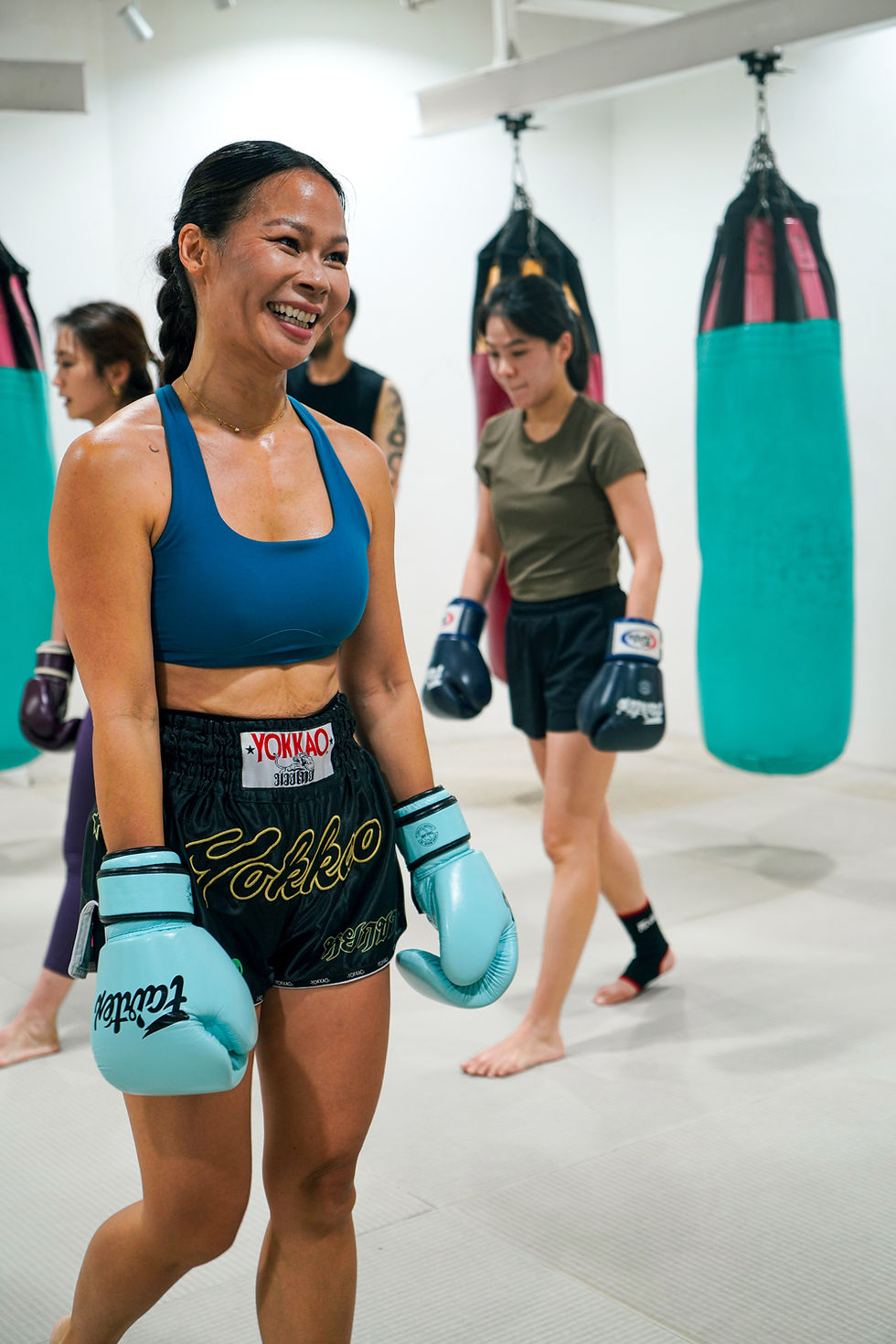
There is also a physical complement at work. Weight training builds the strength base. Muay Thai develops how you use it: hip rotation, rotational power, balance, coordination under fatigue. Women who combine both often find their movement quality in the gym improves alongside their fitness.
When Training Has a Learning Curve
Most gym-based training involves performing movements you already know how to do. A squat is a squat. A lat pulldown is a lat pulldown. You add weight, you track sets, you improve incrementally. The progress is real but the ceiling on novelty is low.
Muay Thai has a technical depth that takes years to explore. In the early weeks, you are working out why your jab keeps dropping and how to rotate your hip properly on a teep. By month three, you are learning to read your partner's positioning during pad rounds. The skill acquisition does not stop, which means the engagement does not stop either.
This matters practically. When your attention is on landing a clean combination, you are not checking your phone between sets or mentally tallying how many minutes remain. The session ends and, fairly often, you are mildly surprised it is over.
Progress markers also shift. You still notice changes in how your clothes fit. But you also notice when a technique clicks that did not click before, when your cardio no longer collapses in the third round, when your footwork becomes something you do rather than something you think about. These are different kinds of feedback. For many women, they turn out to be more motivating ones.
The Confidence Question
There is a version of this that gets said too often and means too little: training gives you confidence. True, but vague. The more specific version is worth saying.
When you have spent several months learning to hit things properly, something changes in how you carry yourself. Your posture shifts. You take up space differently. You are less easily startled. None of this happens dramatically or all at once. It accumulates quietly over weeks of training until one day you notice you are standing differently on the MRT, and you are not entirely sure when that started.
The self-defence dimension is real, though it deserves an honest framing. Muay Thai will not prepare you for every scenario, and anyone who claims otherwise is overselling it. What it does is give you a functional toolkit of strikes, an awareness of distance and positioning, and, perhaps most usefully, the experience of staying calm and thinking clearly when your body is under physical stress. That last quality is genuinely transferable.
There is also something to be said for the simple experience of knowing you can hit hard. Not because you expect to use it, but because the knowledge itself changes how you move through the world. It is a quiet kind of confidence. The women who have it tend not to talk about it much, which is perhaps how you know it is real.
Becoming, as some students put it with complete sincerity, a bit of a badass, turns out to be a surprisingly sustainable source of motivation.
The Social Structure of Training
Gym culture in Singapore tends toward the focused and the independent. Headphones in, programme running, minimal conversation. This suits a lot of people, and there is a real appeal to having an hour that is entirely your own.
Muay Thai classes are built differently. The core of most sessions is pad work with the coach: you work through combinations while your coach holds the pads, corrects your form, and pushes the pace. You are not left to figure it out alone, and the structure means every session has a clear purpose. You end up training regularly with the same small group of people, not in a way that requires effort to maintain. It is just what happens when you show up to the same class on the same days.

For many women, this becomes one of the main reasons they keep coming. Accountability through a gym membership is abstract. Accountability when someone is literally standing there waiting to hold your pads is rather more concrete.
The social environment in a well-run Muay Thai gym also tends to be less charged than some fitness spaces. There is no particular culture of comparison because everyone is at a different stage of learning something genuinely difficult. The person next to you is concentrating on not dropping their guard. They are not observing your technique.
What It Actually Does to Your Body
Muay Thai training is a full-body conditioning format. A typical class combines cardiovascular work through rounds of pad work and drilling, upper and lower body engagement through the mechanics of striking, and core stability through clinch work and balance requirements. These things happen simultaneously, as a byproduct of learning the sport.
The intensity structure, working rounds followed by recovery periods, is effective for cardiovascular fitness and body composition. This is not a claim unique to Muay Thai. Interval-based training is well-documented. The difference is that in Muay Thai, the intervals are shaped by the drill rather than a timer you are watching.
A common concern among women starting out is bulk. The short answer is that this is unlikely. Muay Thai conditioning promotes muscular endurance and lean muscle rather than significant hypertrophy. The women who train consistently for six months to a year tend to describe their bodies as leaner and more capable, rather than noticeably larger.
Posture also changes. The guard position, the hip mechanics, the rotational strength built through thousands of repetitions, these accumulate into a noticeably more upright and centred way of carrying yourself. It sounds minor. It is not something most people fail to notice.
On Stress, Which Is a Real Issue in Singapore
Most forms of exercise help with stress. Muay Thai has a particular quality in this regard: it demands enough cognitive attention that little else fits in alongside it.
Executing a combination on the pads requires you to coordinate your hands, your hips, your feet, your breathing, and your distance management at the same time. This is not compatible with mentally rehearsing a difficult email. The session is one of the few hours in a working Singaporean woman's day where the mental load genuinely pauses.
The physical outlet helps too. There is something straightforwardly satisfying about hitting a pad cleanly after a long day. No particular psychological explanation required.
After training, the tiredness tends to be of the settled variety rather than the agitated kind. This distinction is meaningful if you have spent any time trying to sleep while your mind is still running through the day.
Is It Too Aggressive? The Honest Answer
This question comes up often. The perception of Muay Thai as a combat sport leads some women to assume that walking into a class means being thrown in with competitive fighters.
In a beginner class at a coaching-focused gym, this is not what happens. You are learning stances, basic strikes, and how to hold pads. The contact is between your fist and a pad being held by a partner. Sparring, if it exists in the gym's programme at all, comes much later and is entirely optional for recreational trainees.
Gym quality matters here. A gym with structured beginner pathways, experienced coaches, and a visible mix of recreational and competitive students is generally a safe environment for someone starting from zero. It is worth visiting before committing.

Most women who were apprehensive before their first class describe the experience as less intimidating than they expected. The honest reason for this is that everyone in a beginner class is concentrating too hard on their own technique to pay much attention to yours.
The 12-Month Question
If you are choosing between training formats, the most useful question is not which one produces the best results in a single session. It is which one you will still be doing in a year.
Gym memberships lapse. This is not a failure of character. It is a predictable consequence of training formats that do not generate enough intrinsic motivation to sustain attendance when life gets busy, which in Singapore it reliably does.
Skill-based training tends to hold people better over time. There is always something specific to improve. There are people expecting you to show up. There is a sense of accumulated progress that makes taking a long break feel genuinely costly rather than just slightly guilty.
None of this means Muay Thai is categorically better than gym training. Some people genuinely prefer training alone, making their own programming decisions, and working on their own schedule. That preference is entirely valid.
But if you have renewed a gym membership more times than you have used it consistently, the format might be the issue rather than the motivation. Trying something structured and skill-based is a reasonable next step.
Try a Class at Pineapple MMA
Pineapple MMA runs structured Muay Thai classes in Singapore designed for women with no prior martial arts experience. The first session will feel unfamiliar. That is expected and entirely normal.
Women make up 50 percent of our members here. That is genuinely unusual for a martial arts gym, and it is not marketing talk when we say the environment is welcoming. You can see it in how the gym looks, the cleanliness, the fresh smell when you walk in all the way through to the showers. These are the details that matter when you are deciding whether a space feels like somewhere you want to spend your evenings.
Our coaches have decades of experience training professional female athletes like Zhang Weili and Cris Cyborg. They are not new to the needs of women or how our bodies work when it comes to training. They are professional, focused on getting the job done well for everyone who comes here to get better at Muay Thai.
Most importantly, it is an empowering community of women without the high school drama. Men who train here respect women the way it should be. It is a healthy training environment in class and in sparring.
Sounds too good to be true? Come and feel the difference yourself.
If you would like to see what the training actually looks like, you can book a trial class through our website. Come with comfortable clothes and no particular expectations.


Comments