_edited.png)
Boxing in Singapore’s CBD: Classes, Gyms, and What to Look For
Search for boxing in Singapore’s CBD and the results split into two categories that look similar and are not. The first is boutique fitness boxing: dark rooms, loud playlists, bags in rows, an instructor with a headset counting down intervals. The second is actual boxing: a coach watching your hands, footwork drills that feel awkward for exactly as long as they should, pad rounds where the combination changes because your last one improved. Both will make you sweat. Only one of them is teaching you to box.
This guide is about the second category: where to find real boxing training in the CBD, what to look for when choosing, and what beginners should expect from a proper boxing programme.
The Difference, Concretely
A cardio-boxing studio is a spin class with mitts. The workout is genuine, but the format has no coaching loop: nobody corrects the elbow that flares on your cross, because the format does not allow for it and the instructor is running a playlist, not a curriculum. Six months in, your punches look like they did in week one, delivered with more confidence.
A boxing gym runs a progression. Stance and guard first, because everything is built on them. Then the jab, the cross, hooks and uppercuts, each corrected as it appears. Then footwork that connects punching to moving, defensive fundamentals, and pad rounds that assemble the pieces into combinations. The guide to boxing classes for beginners in Singapore covers what those first weeks look like in detail.
Neither category is wrong. But they answer different questions, and most people typing boxing classes into a search bar at their desk in Raffles Place are asking for the real thing.
What to Look for in a CBD Boxing Gym
Coaching in the class format. Watch whether the coach corrects individuals or performs for the room. A class where your technique is watched and adjusted is training; a class where it is not is choreography.
A structure that goes somewhere. Ask what a member who has trained for six months does differently in class from a member in week one. A real programme has an answer.
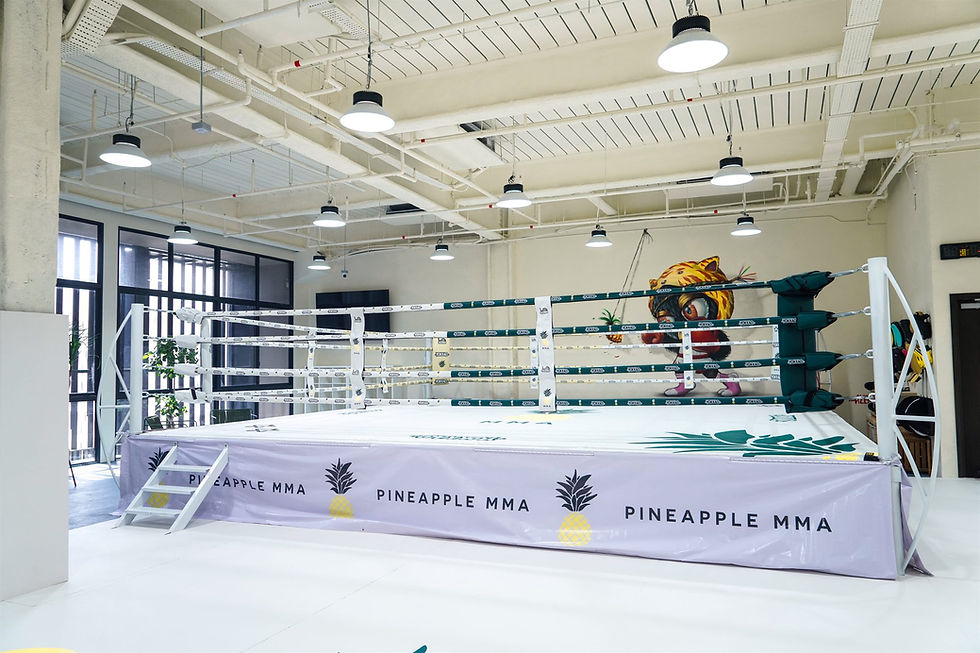
A ring and proper equipment. Not because beginners spar early, but because a gym built around a ring takes the sport seriously, and that seriousness runs through the coaching.
Logistics that survive a working day. Showers you would actually use, a timetable with morning, lunchtime, and evening slots, and a location that does not add a commute to the session.
Boxing at Pineapple MMA
Pineapple MMA at 139 Cecil Street runs Boxing Core classes alongside its Muay Thai programme, in the heart of the CBD between Raffles Place and Tanjong Pagar. The boxing classes follow the same structure that defines the gym’s Muay Thai: one hour, warm-up, technique drilling, pad rounds on a timer, conditioning. Coaches teach boxing as a skill, and the class scales to the person in front of the pads, from first-time beginners to experienced boxers keeping sharp.4

The facility covers what CBD training demands. The training floor holds Singapore’s largest ring at 7x7 metres and eighteen custom Yokkao bags. A full weights room is included in every membership for supporting strength work. The recovery suite has a Brass Monkey ice bath and Finnish sauna. Changing facilities are hotel-grade, with free towels and Dyson hair dryers, which is what makes the lunchtime slot and the pre-work morning session realistic rather than theoretical. Classes run from 6.30am through the evening, seven days a week, with lunchtime classes at 11am, noon, and 1pm covered in the lunchtime CBD training guide.
Boxing or Muay Thai?
The gym teaches both, so this is a question we answer without a horse in the race. Boxing is hands only, which means faster early progress on a narrower skill: head movement, footwork, and punching craft go deep quickly. Muay Thai adds kicks, knees, elbows, and clinch, a wider vocabulary that takes longer to assemble. Fitness outcomes are comparable and excellent in both. Temperament decides it more than logic: some people fall for the precision of boxing, others for the completeness of Muay Thai. The full Muay Thai vs boxing comparison makes the case properly, and a trial class of each settles it better than any article.
Starting as a Complete Beginner
Nobody at a serious gym expects a new member to know anything. The first class requires shorts, a t-shirt, and a water bottle; gloves and wraps can be borrowed or bought at the gym. You will be tired in the first fifteen minutes, your hands will feel slow, and both of those are the normal entry fee. Competence arrives noticeably within a month of consistent training. Half the membership at Pineapple MMA is women, the average member is a working professional rather than a competitor, and the coaching is built for exactly that room.
A Beginner’s First Month of Boxing
The first month follows a recognisable arc, and knowing it in advance removes most of the anxiety that stops people booking the first class.
Week one is coordination chaos, and it is supposed to be. The stance feels like standing wrong on purpose, the jab-cross feels slower than thinking about it, and your forearms tire from holding a guard. Every person in the room ahead of you went through the identical week. Week two, the combinations start connecting without a full mental rehearsal, and the fitness deficit announces itself: the rounds are long and the recoveries are short. Weeks three and four are where the compound interest shows: the guard stays up without reminding, the hips start arriving before the hands, and the pad rounds shift from surviving to working.
Nobody spars in their first month, or in their first several months. Sparring at a serious gym is earned, optional, and heavily controlled when it eventually happens; the sparring for beginners guide covers how that progression works on the Muay Thai side, and the boxing logic is identical. The first month is pads, bags, footwork, and conditioning, and it will be one of the more physically demanding months you have had in years, in the way people tend to mean as a compliment.
Boxing Across the CBD Working Day
The boxing timetable at Pineapple MMA sits inside the same three windows that make the gym work for CBD professionals: mornings from 6.30am, lunchtime slots at 11am, noon, and 1pm, and evenings between 6pm and 8pm, seven days a week across the full programme. The same logistics apply as for the Muay Thai classes: hotel-grade showers, free towels, Dyson hair dryers, and lockers that hold a suit, which is what turns the lunchtime boxing session from a theory into a Tuesday. From Raffles Place the walk is a few minutes down Cecil Street; from Tanjong Pagar, under ten; from Marina Bay, fifteen to twenty along the waterfront.
The practical pattern most boxing members settle into is two to three sessions a week anchored on one fixed slot, usually a lunchtime or a 6.30pm class, with the second session floating around the work week. The weights room, included in membership, covers the supporting strength work in the same visit.
Frequently Asked Questions
Do I need my own gloves for my first boxing class?
No. Gloves can be borrowed for a trial class, and wraps and gloves are available at the gym when you decide to buy your own, which is worth doing within the first few weeks for hygiene and fit.
Is boxing good for weight loss?
Yes, in the same honest range as Muay Thai: a committed one-hour class burns in the region of 600 to 800 calories, delivered as interval training. As always, the diet decides whether the deficit survives the day; the weight loss guide covers the realistic arithmetic.
Will I have to spar?
No. Sparring is optional, months away for a beginner, and gated by coaches when it does arrive. The overwhelming majority of members train boxing for fitness and skill and spar rarely or never.
Is boxing at Pineapple MMA suitable for women?
Half the gym’s membership is women, across both the boxing and Muay Thai programmes, with the same classes, coaches, and standard for everyone. No modified programme, no novelty treatment.
What is the difference between boxing and Muay Thai classes?
Boxing is hands only: punching craft, head movement, and footwork, which go deep quickly. Muay Thai adds kicks, knees, elbows, and clinch. Fitness outcomes are comparable; temperament usually decides. The Muay Thai vs boxing comparison covers the choice in full, and trying one class of each settles it fastest.
The Short Version
If you work in the CBD and want to learn to box, choose a gym that teaches rather than performs. There is one at 139 Cecil Street, a short walk from Raffles Place, Telok Ayer, and Tanjong Pagar, with boxing classes across the morning, lunchtime, and evening windows.
A trial class is $38 and includes the full facility. Book a trial class and bring nothing but kit.


Comments