_edited.png)
Muay Thai and Strength Training: How to Combine Both Without Burning Out
The question arrives in every serious beginner’s second or third month: should I keep lifting weights now that I train Muay Thai, and if so, how do I fit both into a week without wrecking my recovery? The short answer is that the combination is not just workable but better than either alone, provided the week is structured with some intelligence. This article covers why the two complement each other, how to schedule them, and the mistakes that make people quit one or the other unnecessarily.
Why the Combination Works
Muay Thai builds a specific kind of athlete: excellent power endurance, coordination, hip mobility, and the capacity to produce output for an hour. What it does not optimally build is maximal strength. Striking power comes from force delivered fast, and the ceiling on how much force you can deliver is raised in the weights room, not on the pads. A stronger posterior chain kicks harder. A stronger trunk transfers rotation better and absorbs impact better.
The traffic runs the other way too. Lifters who add Muay Thai discover what their gym conditioning was missing: the engine. And for both groups there is the injury-resistance argument, which is unglamorous and probably the most valuable item on the list. Strength training reinforces tendons, ligaments, and joint positions against exactly the repetitive demands that striking sports place on hips, knees, and shoulders.
For fitness outcomes, the pairing covers everything: the interval conditioning and calorie expenditure of the Muay Thai hour, detailed in the calories guide, plus the muscle retention and strength that lifting provides and that neither running nor striking replaces. The Muay Thai vs gym comparison treats the two as rivals because that is the question people search; the better answer for anyone who can manage three to four sessions a week is both.
The Two-Membership Problem
The standard obstacle is logistics. A Muay Thai gym membership plus a commercial gym membership is two fees, two locations, and two commutes, and in the CBD both of those fees are premium. The schedule friction is usually what kills the lifting half of the plan.
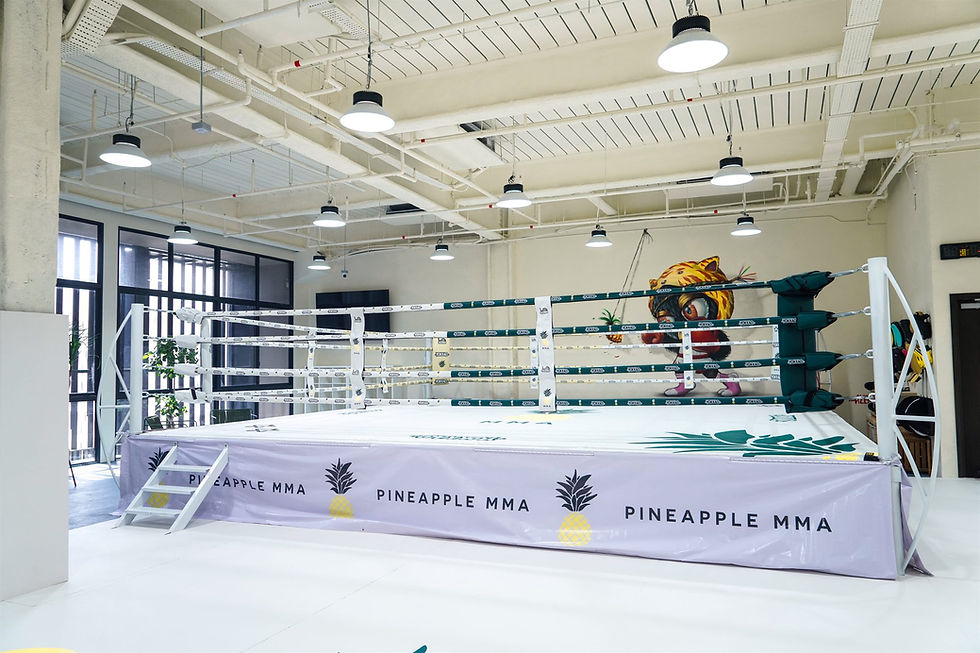
This is worth stating plainly because it shaped the facility: Pineapple MMA’s weights room is included in every membership, in the same 7,000 square feet as the training floor. Squat rack, deadlift platform, three bench stations, dumbbells, kettlebells, treadmills, a rower, and an assault bike, adjacent to the mats. Lift before class, after class, or on rest days; one membership, one location, one commute. The full facility breakdown covers what else is on the floor.

How to Structure the Week
The right structure depends on your priority. Three honest templates:
Muay Thai first (most members): three Muay Thai classes and two short lifting sessions per week. Lift on non-class days or directly after class, never directly before. Keep the lifting simple: squat or deadlift pattern, press, pull, trunk work, forty-five minutes.
Balanced: two classes, two lifts, with at least one full rest day. This is the sustainable default for a working professional and pairs well with the schedule advice in the training frequency guide.
Strength first: three or four lifting sessions with one or two Muay Thai classes as conditioning. Common among experienced lifters using Muay Thai to replace the cardio they were never doing anyway.
In all three, the sequencing rule is the same: hard lifting and hard pad work on the same body parts belong on different days, or at minimum in the order class-then-lift. Squatting heavy an hour before a Core class produces a bad class and a worse knee day.
The Recovery Budget
Adding a second training modality does not double your recovery needs, but it does spend from the same budget: sleep, food, and rest days. The signals of overreach are reliable: performance dropping across both activities, resting heart rate creeping up, and the particular flatness that the recovery and sleep guide describes in detail. When they appear, cut volume before you cut either activity entirely.
The recovery suite at the gym earns its floor space here. Contrast therapy in the Brass Monkey ice bath and the sauna after heavy weeks does for a double-modality schedule what the ice bath guide describes: it does not replace sleep, but it measurably helps the legs that trained five times that week.
Mistakes That End the Experiment
Lifting like a bodybuilder while training like a fighter. Five weekly lifting sessions plus three classes is a professional athlete’s load on an amateur’s sleep. Something will give, and it is usually a tendon.
Treating soreness as a schedule. Soreness is information, not a badge. Persistent soreness means the week is structured wrong.
Redundant conditioning. If you train Muay Thai three times a week, you do not also need HIIT classes. The pads are your intervals; let the lifting be lifting.
Quitting the weights the first busy month. When time compresses, cut lifting volume to one maintenance session rather than zero. Strength holds remarkably well on one session a week; it just does not build.
What to Lift: A Minimal Programme That Supports Striking
The lifting that supports Muay Thai is simpler than the internet suggests. You are not programming for a bodybuilding stage or a powerlifting meet; you are raising general force capacity and armouring joints, twice a week, in forty-five minutes. A session that covers it:
One squat or hinge pattern: back squat, goblet squat, trap-bar deadlift, or Romanian deadlift. Three or four working sets of five to eight repetitions, at a weight that leaves two reps in the tank.
One press: bench press, dumbbell press, or overhead press. Three sets of six to ten.
One pull: rows or pull-ups. Three sets, matched to the press.
Trunk and carry work to finish: suitcase carries, pallof presses, or hanging knee raises. Striking rewards a trunk that resists rotation as much as one that produces it.
Alternate two versions of that session, add weight gradually, and that is the entire programme. It fits in the weights room next to the training floor, before or after class or on rest days, and it is deliberately boring; the interesting training happens on the pads, and the lifting exists to make it hit harder and break less. What it does not need to include is extra conditioning: no finishers, no circuit at the end. Your conditioning is Tuesday’s Core class, and the calories guide shows what that hour already costs.
Signs the Balance Is Right, and Signs It Is Not
The balance is right when both activities are trending: kicks feel heavier on the bag, the bar keeps creeping up, and you arrive at most sessions wanting to be there. Strength gains will be slower than a pure lifting programme would deliver, and that is the accepted price of also becoming someone who can fight for an hour.
The balance is wrong when one side flatlines for weeks while the other continues, when sleep quality drops despite tiredness, or when small pains start rotating through different joints. The order of fixes is always the same: check sleep first, then cut lifting volume by a third, then drop one class. Cutting food is not on the list; under-eating while double-training is the fastest route to the flatness the recovery guide warns about.
Frequently Asked Questions
Should I lift weights before or after Muay Thai class?
After class, or on separate days. Lifting heavy before a Core class degrades the class and raises injury risk in fatigued legs. If both must happen in one visit, the order is class, then lift, and keep the lifting session short.
Will lifting weights make me slow for Muay Thai?
No. This is the most persistent myth in striking sports. Strength raises the ceiling on how much force you can produce quickly; slowness comes from excessive muscle mass gained over years of dedicated hypertrophy work, which two supporting sessions a week will not produce.
How many rest days do I need training both?
At least one full rest day a week, and most working professionals do better with two. The combined load of two classes and two lifts with two rest days is sustainable indefinitely; five hard days a week on amateur sleep is not.
Can I build muscle while training Muay Thai?
Yes, modestly, provided you eat enough. The interval conditioning of classes raises energy expenditure substantially, so muscle gain requires deliberately covering that cost with food, particularly protein. Expect slower gains than a pure lifting block and better conditioning than any pure lifting block.
Do I need a separate gym membership to lift weights?
Not at Pineapple MMA. The weights room, with squat rack, deadlift platform, three bench stations, dumbbells, kettlebells, and cardio machines, is included in every membership, on the same floor as the ring at 139 Cecil Street.
The Practical Setup
Two classes and two lifts a week, under one roof and one membership, with a recovery suite down the corridor, is a complete physical programme by any honest standard: skill, conditioning, strength, and recovery, in about five hours a week.
A trial class at Pineapple MMA is $38 and includes the weights room and recovery suite on the same visit. Book a trial class at 139 Cecil Street and see the whole floor.


Comments