_edited.png)
What Age Should My Child Start Muay Thai? A Guide for Singapore Parents
- Mar 24
- 8 min read
This is almost always the first question parents ask. Not which gym, not what it costs, not whether the class times work. What age. Because before any of those things matter, a parent needs to know whether their child is even at the right stage for this.
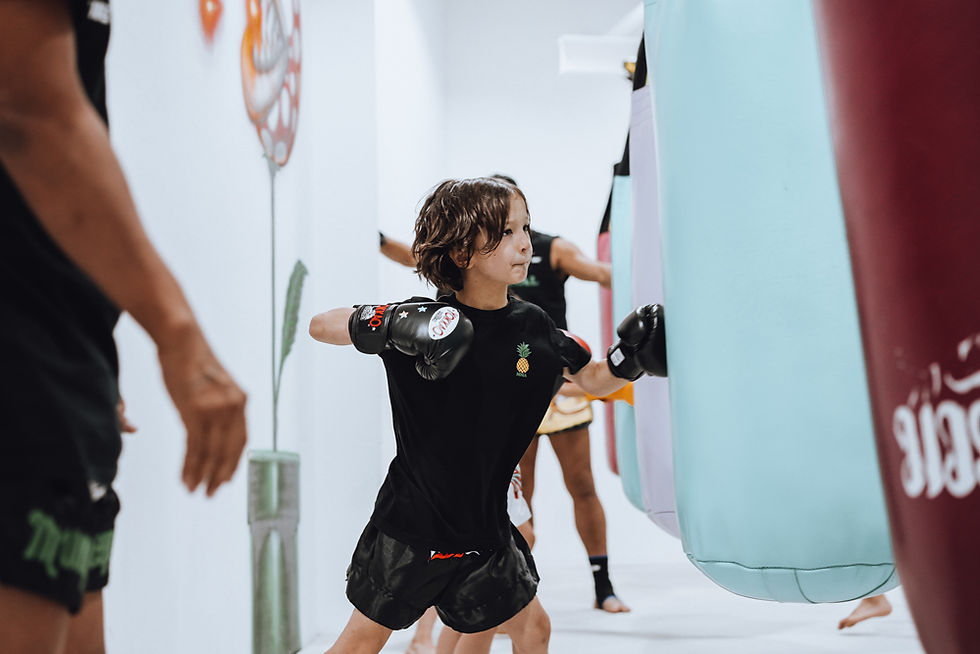
The honest answer is that most children are ready for a structured Muay Thai programme by the time they are five or six, provided the gym has a curriculum designed specifically for that age group. But age is genuinely a secondary consideration. Readiness indicators matter more than the number, and a seven-year-old who cannot yet follow a two-step instruction is less ready than a focused five-year-old who can.
What follows is a practical guide to what readiness actually looks like, what children get out of Muay Thai at different stages, and how to assess whether your specific child is ready to start.
Why Age Is Only Part of the Answer
Many parents arrive at this question after reading something general about martial arts and children, which tends to offer answers like "any age is fine" or "as young as three." These answers are not wrong exactly, but they are referring to very broad categories of children's activity, not to structured striking martial arts with partner work and pad sessions.
Muay Thai for children requires a few specific things that have more to do with developmental readiness than with age. A child needs to understand that techniques are for the gym and not for the playground or the living room. They need enough coordination to work safely with a partner and with pads. They need to be able to follow multi-step instructions from a coach without constant redirection. And they need some capacity to regulate their energy, meaning they can calm down and listen when the coach is explaining something, not just when they are moving.
Most children develop these capacities somewhere between five and seven. Some earlier, some later. The range is wide enough that a child's age on paper tells you less than ten minutes of watching them in a trial class.
Muay Thai Versus Other Martial Arts for Young Children
It is worth distinguishing Muay Thai from other martial arts when thinking about starting age, because they are not all the same. Brazilian Jiu-Jitsu, for example, involves grappling and positional control with a partner, which some children can engage with meaningfully from a younger age because the movements are slower and the physical consequences of error are lower. Muay Thai involves striking, even in its most controlled and padded junior form, which requires more developed coordination and body awareness to do safely.
This is not a reason to delay unnecessarily. A well-structured Muay Thai programme for young children is built around movement games, coordination exercises, and introductory technique at very low intensity. Children are not hitting each other in a junior class. The pad work is supervised, the contact is controlled, and the progressions are deliberately paced. The point is that a gym with a serious junior curriculum has thought carefully about how to introduce the sport at each age, and that curriculum matters as much as your child's age when choosing where to start.
What to Expect at Each Age
As a general reference, here is how children’s development tends to map to what they can engage with in Muay Thai training. Keep in mind that classes at most quality gyms are grouped by skill level rather than strictly by age — which means your child trains at the level they are actually at, not the level their birthday suggests:
Age | Training focus | What class looks like |
5–6 | Movement, coordination, listening skills, basic body awareness | Games, simple movement patterns, introductory technique. Short sessions, high engagement. |
7–9 | Fundamental technique, balance, spatial awareness, basic pad work | Structured drilling, partner work at low intensity, building the technical foundation. |
10–12 | Combinations, footwork, timing, light controlled contact | More complex sequences, developing rhythm and reaction. Technique becoming instinctive. |
13+ | Full technical curriculum, conditioning, tactical understanding | Training closely resembles the adult programme. Full pad rounds, sparring when appropriate. |
The age ranges above are a developmental reference, not a class structure. In practice, a well-run gym places children according to where they actually are technically and physically. A coordinated and focused eight-year-old may be working on material well beyond what the numbers suggest. An eleven-year-old joining for the first time starts at the foundation, because the technical base needs to be built correctly before anything else happens.
Signs Your Child Is Ready to Start
Rather than waiting for a specific birthday, look for the following: your child can follow a two or three step instruction from an adult who is not a parent, they can participate in a group activity without constant individual supervision, they understand that physical contact in a class setting has rules, and they have expressed some genuine interest in trying it. That last point matters more than it might seem. Children who are enrolled because a parent decided it would be good for them, without any curiosity or enthusiasm of their own, tend to disengage quickly.
Interest does not need to be intense or longstanding. A child who saw Muay Thai on television and asked a question, or who has a friend who trains, or who simply likes the idea of learning something physical and structured, is starting from a useful place. For families new to Singapore, it is also worth noting that Muay Thai offers something few other sports can: a genuinely distinctive athletic foundation, a sport that is physically demanding, deeply technical, and still rare enough that most children in a school will not have tried it. That combination tends to hold attention in a way that more familiar activities sometimes do not. The sport builds its own motivation once children are in it, particularly as they develop skill and feel the satisfaction of getting something right that was difficult before.
What About Quieter or More Reserved Children
Parents of quieter children sometimes wonder whether a martial art is the right environment. In practice, structured Muay Thai classes tend to work well for children who find unstructured social situations more demanding, because the environment is clear: there is a coach, there are specific things to learn and practise, and the progression is visible. Confidence in this context is earned through competence rather than through social performance, which suits many children who are reserved in less structured settings. The full piece on how Muay Thai builds confidence in quieter children is covered separately if this is a specific consideration for your family.
For Singapore parents specifically, this carries beyond the gym. Primary school classrooms here are not small. A child entering Primary 1 will find themselves in a class of thirty or more unfamiliar faces, expected to participate, follow instructions from a teacher they have never met, and navigate an entirely new social environment, often all in the same week. For a shy child who has had limited experience in structured group settings outside the family, that is a significant ask.
Sport, and structured group training in particular, prepares children for exactly this. A Muay Thai class is, at its core, a classroom: there is a coach giving instructions, there are peers to interact with, and participation is expected from everyone. A child who has learned to manage nerves in that environment, to attempt something in front of others, to warm gradually to new faces and find their footing in a group, has already been practising what school will demand. The confidence that develops is not abstract. It shows up in whether they raise their hand in class, whether they can introduce themselves to a classmate they do not know, whether they hold their composure when the environment feels unfamiliar.
Quieter children who train consistently tend to find school social dynamics more manageable over time. Not because martial arts functions as a therapy, but because training is where they have been practising the relevant skills in an environment where expectations are clear, feedback is immediate, and there is no academic pressure attached. Sport is the ideal ice-breaker. It teaches children how to interact with other kids in a context that is physical and fun, which makes the social part feel like a by-product rather than the objective. Those skills, built in a training hall, carry directly into the classroom.

What If It Does Not Click Straight Away
The first few sessions of any new activity have a settling-in period. Children are learning the environment, the coach, the class structure, and the techniques simultaneously, which is a lot. A child who comes home from the first class seeming uncertain has not necessarily found the wrong fit. Give it four to six sessions before drawing conclusions, provided the child is willing to keep attending and is not actively distressed.
If after several sessions a child genuinely does not want to be there, that is worth listening to. Muay Thai is not the right activity for every child at every stage. But most children who try it in a well-run programme and give it a genuine chance find something they want to continue. The combination of physical activity, skill development, structure, and the social environment of a class tends to work well for a wide range of children.
There is a larger point here about what the parent’s role actually is. Discomfort in a new environment is not a sign that something is wrong. It is a sign that the child is in a new environment. A child who arrives at a first session nervous, uncertain, and reluctant to participate is responding completely normally. Part of a parent’s role in moments like that is to stay calm, acknowledge the feeling, and gently hold the line. Not to immediately conclude that the activity is the wrong fit and take them home. Children need adults to help them push through early discomfort. That is not coddling in reverse; it is parenting.
The routine question is a separate one, and it is worth being direct about. Children have moods. A five-year-old who genuinely loves their training class on Tuesday may wake up on Saturday morning and announce, with complete conviction, that they never want to go again. This is not useful data about the sport. It is a five-year-old having a difficult morning. Parents who respond by cancelling the session, week after week, are not reading meaningful signals. They are allowing the child’s temporary state of mind to make a decision the child does not have the perspective to make. The momentum for the child disappears, not because they stopped enjoying the activity, but because the habit broke. Once the routine goes, re-establishing it means starting from scratch.
Singapore parents will recognise the logic. Nobody asks whether a child feels motivated before sending them to Chinese tuition or mathematics class. The reasoning that gets applied to academic enrichment should apply here too. If the activity is good for your child, structured, safe, and building something real, a Saturday morning of resistance is not a reason to stop going. It is a reason to bring a snack for the ride.
The Children's Programme at Pineapple MMA
Pineapple MMA's children's Muay Thai programme is structured around skill level rather than age, which means children train with peers at the same stage of development rather than just the same birthday year. Classes build the technical and physical foundation progressively, coaches work with each child at their actual level, and the environment balances the discipline of a proper martial arts class with the energy and enjoyment that keeps children engaged.
If you are trying to assess whether your child is ready, the most straightforward approach is a trial class. It gives your child a real experience of the environment and gives you a much clearer picture than any description can. Book a trial class here. For more on how to evaluate programmes and what to look for in a children's martial arts gym, the guide to choosing the right programme for your child covers this in detail.
The Short Answer
Most children are ready to start a structured Muay Thai programme from around five to six years old, provided the gym has a curriculum built for that age. Readiness indicators matter more than the specific age: can your child follow instructions, engage with a group activity, and understand that the techniques stay in the gym.
Starting earlier is not necessarily better. Starting at the right time for your specific child, in a gym with a serious junior programme, produces better outcomes than rushing it by a year or two. The sport will still be there when your child is ready for it. In most cases, they already are.


Comments